

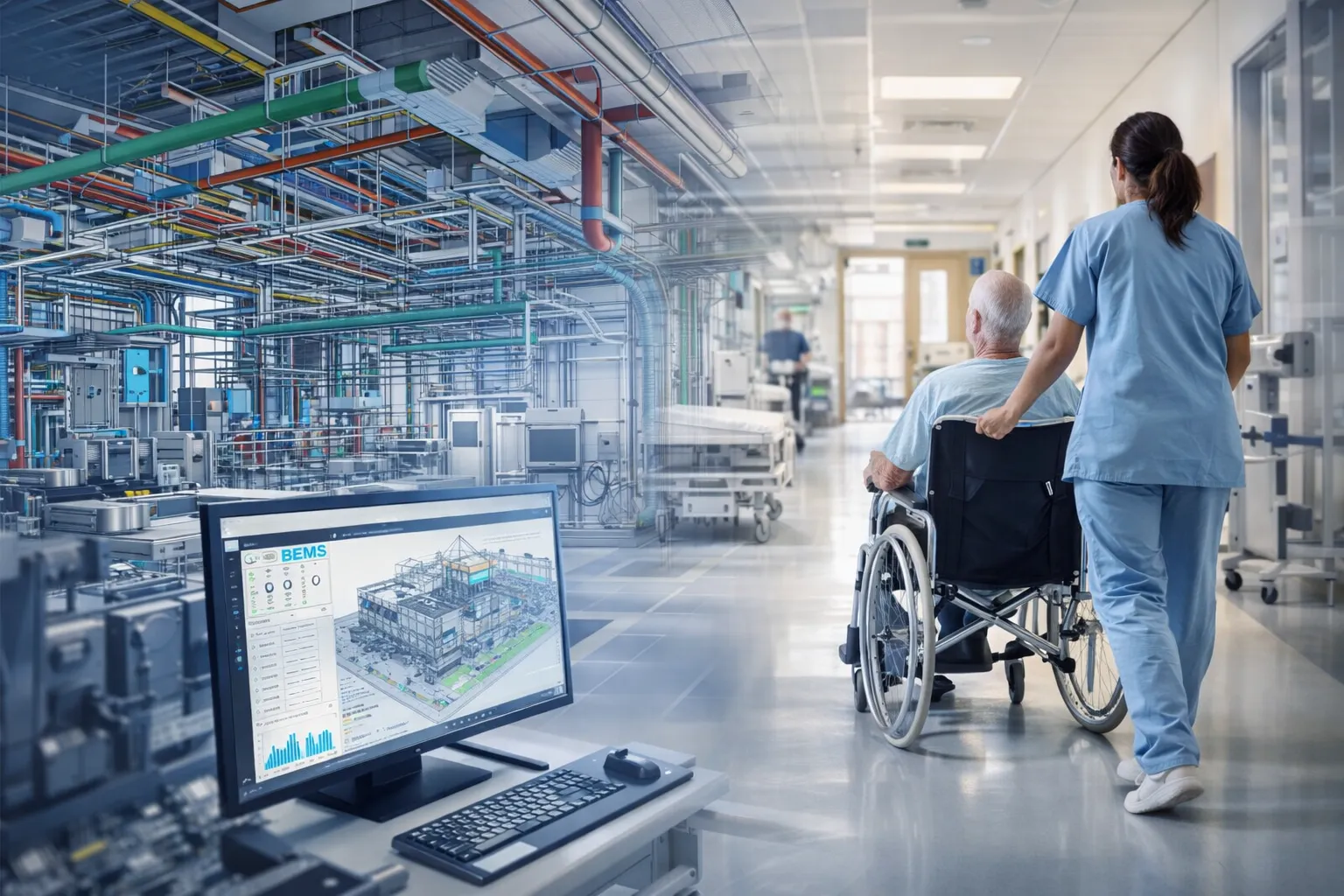
What Is BEMS—and Why Is It Essential for Healthcare?
A Building Energy Management System monitors, controls, and optimises a range of building services including:
- Ventilation and air quality
- Heating and cooling
- Pressure regimes
- Humidity control
- Energy use and demand
- Critical alarms and system integration
In healthcare settings, these functions are not simply operational—they are clinical enablers. Sub‑standard environmental controls can undermine infection prevention measures, reduce diagnostic accuracy, jeopardise patient wellbeing, and compromise staff safety.
1. Infection Prevention and Control (IPC)
Hospitals rely on BEMS to maintain safe and stable air change rates, pressure cascades, and filtration performance in areas such as:
- Operating theatres
- Intensive care units
- Isolation rooms
- Sterile services
A poorly tuned system can allow contaminants to migrate, undermine sterile fields, or reduce filtration effectiveness. An optimised BEMS, however, supports consistent IPC compliance and protects clinical environments.
2. Clinical Environment Stability
Certain procedures and equipment require precise temperature and humidity conditions to function correctly. BEMS ensures stability essential for:
- Surgical accuracy
- Drug storage integrity
- Laboratory testing conditions
- MRI, CT, and other diagnostic equipment performance
By providing real‑time monitoring and rapid response capabilities, BEMS safeguards operational continuity.
3. Energy Efficiency and Carbon Reduction
The NHS is the UK’s largest single emitter of carbon within the public sector, and hospitals are some of the most energy-intensive buildings. BEMS plays a leading role in:
- Reducing energy waste
- Optimising demand patterns
- Lowering operational costs
- Supporting net‑zero carbon strategies
For estate and energy managers, BEMS is the most powerful intervention available to balance cost control with clinical performance.
4. Regulatory Compliance
Healthcare facilities must meet strict legislative and technical standards, including:
- HTMs (Health Technical Memoranda)
- HBNs (Health Building Notes)
- CIBSE guidance
- BREEAM Healthcare
- Net Zero NHS mandates
BEMS provides the data, control, and reporting needed to evidence compliance and maintain safe operation.

Why an In‑House BEMS Specialist Makes a Difference
Most consultancies must bring in external BEMS expertise during design, commissioning, or troubleshooting. This adds cost, increases review times, and often leads to fragmented decision‑making.
DSSR’s in‑house BEMS specialist provides a level of integration and insight that is exceptionally rare in the industry.
1. Deep Technical Continuity—From Concept to Commissioning
Having in‑house capability means BEMS expertise is embedded throughout every stage of a project:
- Early-stage concept design
- System strategy development
- Detailed control philosophy creation
- Review of contractors’ proposals
- Site inspections and commissioning support
- Post-occupancy optimisation
This continuity reduces risk, improves system performance, and ensures the design intent is protected end‑to‑end.
2. Faster Problem‑Solving and Expert Oversight
Healthcare BEMS failures can be costly and dangerous. Having an internal specialist means:
- Rapid interpretation of BEMS data
- Immediate identification of root causes
- Independent verification of contractor performance
- Preventative advice to avoid system downtime
Clients gain confidence knowing an expert is available without delays or additional fees.
3. Better Integration with Mechanical & Electrical Engineering
BEMS is not a standalone discipline—it’s the control system that connects every M&E component. DSSR’s in‑house specialist ensures:
- Systems communicate correctly
- Control strategies are logical and energy‑efficient
- Sensors and plant are integrated properly
- The whole building operates cohesively, not as isolated systems
This results in more reliable environments, lower operational costs, and improved longevity of assets.
4. Increased Client Value and Reduced Life‑Cycle Costs
By eliminating the need for external BEMS consultants, clients benefit from:
- Reduced consultancy fees
- Faster turnaround times
- A single point of responsibility
- Higher accuracy in design and verification
- More robust performance across the building’s life cycle
This makes DSSR a more efficient and cost‑effective partner—particularly in large-scale, high‑complexity healthcare projects.
A Hidden Specialist Driving Healthcare Performance
In the healthcare sector, BEMS is far more than an energy tool—it is a clinical safeguard, a compliance enabler, and a strategic asset. Its role affects patient outcomes, operational stability, estate resilience, and long‑term sustainability.
By offering in‑house BEMS expertise, DSSR delivers a service that few others can match. It ensures our healthcare clients benefit from better-designed systems, smoother commissioning, reduced risk, and buildings that perform exactly as intended—in both clinical and environmental terms.
Explore How DSSR Can Support You Further
If you’re looking to enhance building performance, improve environmental control, or take meaningful steps towards smarter, more sustainable estates, DSSR offers dedicated expertise in Smart Building Automation. Our team helps clients unlock the full potential of intelligent systems — from advanced BEMS integration to data‑driven optimisation and long‑term building efficiency strategies.



The Critical Importance of BEMS in Healthcare
Modern healthcare estates are some of the most complex and demanding environments in the built environment sector. From surgical theatres to laboratories, isolation rooms to critical care wards, every area relies on precise environmental control to ensure patient safety, clinical performance, operational efficiency, and regulatory compliance.
At the heart of this intricate ecosystem sits an often-underappreciated cornerstone: the Building Energy Management System (BEMS).
While many organisations outsource BEMS expertise, DSSR is one of the few consultancies to offer in‑house, dedicated BEMS specialism—delivering deeper insight, faster problem‑solving, and a higher standard of assurance to our healthcare clients. DSSR has been delivering Smart Building Automation for over 30 years.